The Legal Floor, With Citations
Most of what people believe about California's insurance requirements is roughly right and imprecisely held. Here is the actual shape, with the sources.
Financial responsibility, not 'insurance' as such
What California requires is proof of financial responsibility. Liability insurance is how nearly everyone satisfies it, but the underlying obligation is the broader one. The DMV publishes its insurance requirements page describing the acceptable forms.
The minimum limits
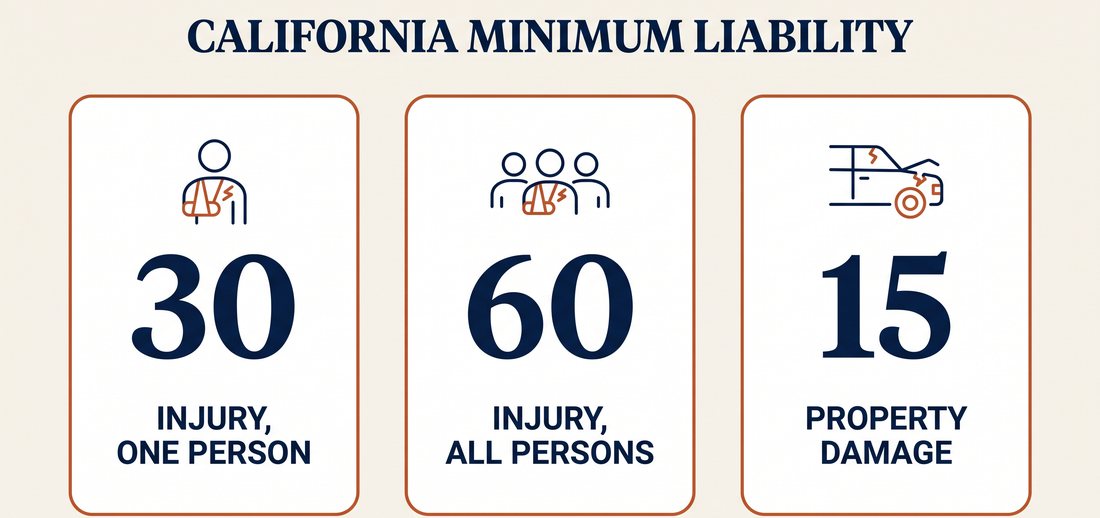
California Insurance Code section 11580.1b sets out the minimum liability coverage a policy must provide: $30,000 for injury or death of one person, $60,000 for injury or death of more than one person, and $15,000 for property damage. Written the short way: 30/60/15.
Carrying proof
Vehicle Code section 16028 requires drivers to carry evidence of financial responsibility and to provide it when requested by a peace officer or following an accident. California accepts electronic proof, so the card on your phone counts.
The consequences of not having it
Vehicle Code section 16029 provides for penalties for driving without the required coverage, and driving privileges can be affected. The financial exposure of causing an accident uninsured is generally far larger than the fine.
Insurance follows registration too
Registering a vehicle involves demonstrating coverage, and lapses can affect registration status. This is why a policy that quietly cancels for non-payment can produce a DMV problem some weeks later.
What the law does not require
Collision and comprehensive coverage on your own vehicle. Those are optional under the law — though a lender will usually require them as a condition of financing, which is a contract, not a statute.
Want a policy that meets the requirement? We'll quote it today.
Meeting the requirement is not the same as being protected
It is worth separating the two ideas cleanly, because the law does not attempt to answer the second one. The statutory minimums exist so that a driver can register a vehicle and take responsibility for a certain amount of harm. Whether that amount matches what you could actually cause, or what you could pay above it, is a question about your circumstances that no statute addresses. Satisfy the law first — it is not optional — then decide the separate question of how much protection you actually want.
Get this quoted for your situation
Free quotes from multiple carriers, prepared by a licensed California agent. Two minutes, no obligation.
Get My Free QuoteMore of what callers ask
Is a digital insurance card acceptable in California?
Yes — electronic proof is accepted, so showing the card on your phone is valid. Keeping it accessible without a signal is a practical precaution.
Do I need insurance if my car is parked and not driven?
A vehicle that isn't being driven may have options such as planned non-operation status through the DMV. Check the DMV's requirements rather than simply letting coverage lapse.
Is minimum coverage enough to protect me?
It satisfies the law. Whether it protects you depends on what you could pay personally above the limits, which is a different question entirely.