The Four Ways Californians Satisfy the Law
California does not, strictly speaking, require you to buy car insurance. It requires you to demonstrate financial responsibility — the ability to pay for harm you cause. An insurance policy is how almost everybody satisfies that, but it is not the only route the Vehicle Code recognizes.
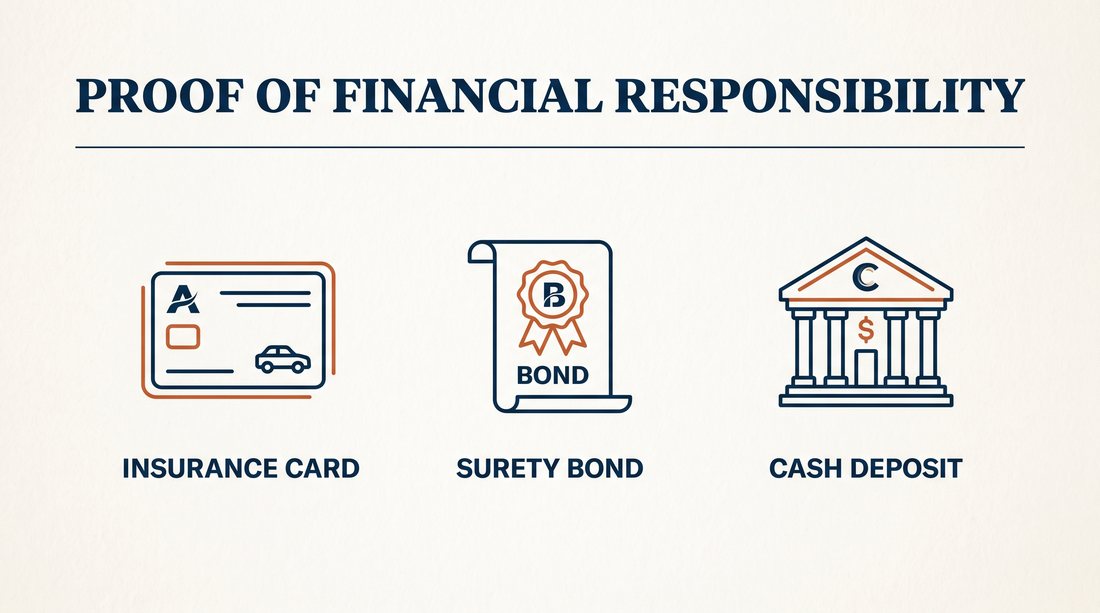
1. An insurance policy
The overwhelmingly common answer. The policy must meet at least the liability minimums that Insurance Code section 11580.1b sets: $30,000 for injury or death of one person, $60,000 for injury or death of more than one person, and $15,000 for property damage. Vehicle Code section 16028 requires you to carry evidence of it and to produce that evidence when a peace officer asks or after a collision.
2. A cash deposit with the DMV
The department will accept a deposit of cash held against your obligations. The amount is set by the state and the DMV publishes it. In practice this route makes sense for very few people, because the sum tied up is substantial and it does nothing beyond satisfying the requirement — no adjuster, no legal defense, no help at all when a claim actually happens.
3. A surety bond
A bond from a company licensed to write them in California, in the amount the state requires. Same observation as the deposit: it satisfies the statute and it does not defend you.
4. A DMV certificate of self-insurance
Issued to owners of larger fleets who can demonstrate the resources to cover claims themselves. The DMV publishes the criteria, including the number of vehicles involved. This is a commercial answer, not a household one.
What proof looks like at the roadside
For the overwhelming majority of drivers it is an insurance card, paper or electronic, showing current coverage on the vehicle. For the other three routes it is the document the DMV issued — the certificate, not a letter about it. Keep it where you can produce it, because producing it is the actual legal duty.
Why almost everyone chooses the policy
The three alternatives satisfy the law and leave you facing a claim alone. A policy brings a carrier that investigates, negotiates, defends and pays within its limits. That difference is the whole reason insurance became the default answer rather than the technically-permitted one.
If the driver behind the question is trying to find the cheapest lawful way to be on the road, the honest answer is usually a properly-shopped minimum policy rather than an exotic filing — we will show you what that costs.
Get this quoted for your situation
Free quotes from multiple carriers, prepared by a licensed California agent. Two minutes, no obligation.
Get My Free QuoteMore of what callers ask
Is a cash deposit really an option?
Yes, the Vehicle Code recognizes it, and the DMV publishes the amount required. It is legal and it is rarely sensible, because the money is tied up and no one is defending you when a claim arrives.
Does the minimum policy satisfy the law on its own?
A policy meeting the limits in Insurance Code section 11580.1b satisfies the financial-responsibility requirement. Whether it protects your assets in a serious crash is a separate question worth asking.
What do I show an officer?
Evidence of current coverage on the vehicle — an insurance card in paper or electronic form, or the DMV-issued document if you satisfied the requirement another way. Section 16028 is the provision that requires you to produce it.